Surroundings
Chiloéaround you
Tourist attractions, activities, places of interest and the rich Chilote culture just minutes from your plot.
Surroundings
Tourist attractions, activities, places of interest and the rich Chilote culture just minutes from your plot.
Tourist attractions
You will find a picturesque seaside resort just 10 km from the project, bearing the same name as the municipality. In this town of around 8,300 inhabitants, also known as «the land of a thousand landscapes» — a name given to it by the author Francisco Coloane — you can wander its colourful streets, admire the wooden houses clad in larch shingles and enjoy rich cuisine in various cafés, restaurants and local eateries.
You can browse the different local shops and the large artisans' market, and take in the landscape of the bay by walking along the waterfront. You can also visit the museum of the writer Francisco Coloane, housed in a typical Chilote house from the early 20th century, of the palafito (stilt house) type, with a recreation of the furniture of the period.
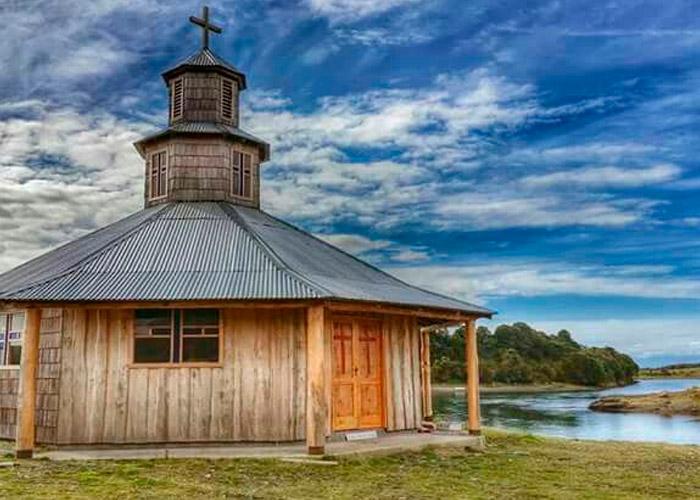
You must not miss the Church of Colo, located in the village of Colo. It was built at the end of the 19th century in coigue and cypress wood on a stone base. It was declared a National Monument in 1999 and is one of the 16 churches declared a World Heritage Site by UNESCO in the year 2000.
Within the municipality lies the town of Quicaví, considered in Chilote mythology to be the site of the cave of the Witches of Chiloé. (But be careful: if you ask a local about its existence or location, they will tell you they are «pure myths»).
Stone artefacts have been found that prove human settlements dating back at least 4,675 years BP (before present).
Known for its Catholic chapel, a cemetery, a botanical park and a 437 m footbridge that connects it to the Big Island of Chiloé. Because of its cemetery, it is also known as the «island of the wandering souls».
It is characterised by its palafito (stilt) houses, in which people still live, and by a small museum that tells the story of its inhabitants.
The largest of the Chauques islands. During high tide, some sections become separated, forming temporary islands. Approximately 70% of its surface is covered by natural vegetation.
Places of interest in Chiloé
The name means «place of dalcas». It is a town full of charm, where you can visit the Plaza de Armas and the waterfront, and see the spectacular Nuestra Señora de los Dolores church, 26 metres tall, built in 1849 and declared a World Heritage Site in 2000. Nearby are San Juan and Tenaún, two small towns whose churches are also recognised as World Heritage Sites.
Located at the southern tip of the Big Island of Chiloé, it marks the point where the Pan-American Highway 5 South ends (the «km 0 milestone»). From here the doors open to the south of Patagonia and the Guaitecas Archipelago. Boat trips are highly recommended for observing marine flora and fauna, with the chance of spotting cetaceans such as the blue whale.
An incredibly beautiful place, completely removed from civilisation, with striking scenery and rural areas. Ideal for camping and for enjoying great dunes, virgin forests and long beaches of white sand stretching for nearly 20 km.
A small town of great beauty, built on natural terraces on the slope of a hill, with wooden houses from the early 20th century. Here you can visit the Museum of Chonchi Traditions.
Three waterfalls located 20 km from Dalcahue. They form where the Tocoihue river crosses a drop of some 60 m in height shortly before reaching the sea.
Tantauco National Park: one of the places with the greatest biodiversity in the world, with ancient forests, peat bogs and large lakes spread over 118,000 hectares. It has trails, viewpoints and shelters built from Guaitecas cypress.
Tepuhueico Park: a private conservation initiative with 20,000 hectares of native forest between Lake Tepuhueico and the Pacific Ocean.
Chiloé National Park: Valdivian rainforest predominates, with dense evergreen forest. Its main attractions are Lake Cucao, the coastal dunes and the sea lion colonies.
Chilote culture
The typical dishes, the local products, the sheep's wool crafts, the architecture and the music are the perfect setting for a Chiloé full of mythology.
Chilote mythology was born from the mixture of the ancient religions of the Chono and Huilliche peoples who inhabited this area, and of the legends and superstitions brought by the Spanish conquistadors from 1567 onwards. This mythology grew and flourished thanks to the isolation experienced by the archipelago.
There is a hierarchy within Chilote mythology. The highest rank belongs to Tenten Vilu and Caicai Vilu, who, in a legendary struggle, created the Archipelago. Next comes the Millalobo as King of the seas, together with his wife Huenchula and their children: Pincoy, prince of the seas, and Pincoya and the Chilote mermaid as princesses.